

MD&A · 2025
In this section4 topics
Overview of Operations
Overview of Operations
Revenue growth in 2025 was primarily driven by the Group’s core businesses, which continued to expand steadily through the enhancement of service channels, the development of new products and solutions tailored to evolving customer needs, and the strengthening of long-term customer relationships.
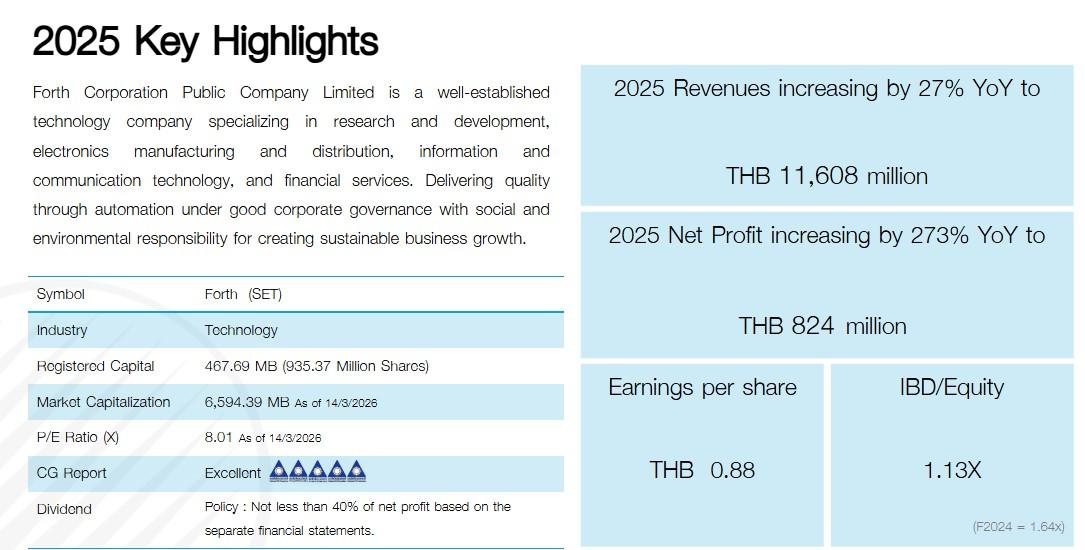
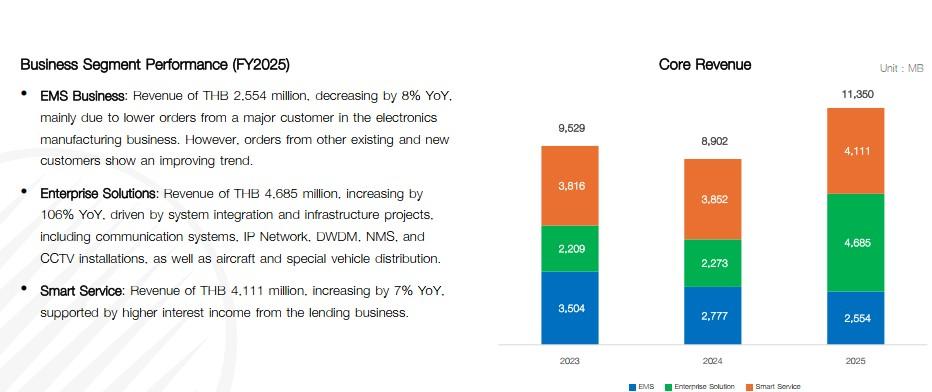
The Group reported total revenue of THB 11,608 million for 2025, representing an increase of THB 2,459 million, or 27%, compared to THB 9,149 million in 2024. This growth was largely attributable to the strong expansion of the Enterprise Solutions business, which remained a key driver of the Group’s overall performance.
In terms of profitability, the Group recorded net profit of THB 824 million in 2025, an increase of THB 603 million, or 273%, from THB 221 million in the previous year. This significant improvement was mainly driven by higher gross profit margins in both the Enterprise Solutions and Smart Service businesses, reflecting enhanced cost efficiency and improved quality of earnings.
At the same time, the Group remains committed to conducting its business in alignment with Environmental, Social, and Governance (ESG) principles. This includes the development of solutions that enhance resource efficiency, the delivery of high-quality services with consideration for stakeholders, and the adherence to strong corporate governance practices. These efforts contribute to building long-term resilience and sustaining earnings growth.
Furthermore, a more diversified revenue structure has strengthened the Group’s operational flexibility and reduced reliance on any single revenue stream. This has enabled the Group to maintain stable revenue performance amid economic volatility, while supporting a balanced approach to both financial performance and sustainable growth.
Operating Results & Financial Condition
Operating Results & Profitability
Despite the increase in operating costs in line with business expansion, the Group successfully sustained its gross profit margin at 25%, underscoring its continued effectiveness in cost management and the disciplined execution of its pricing strategies.
With respect to selling and administrative expenses, the Company maintained a prudent and disciplined approach while simultaneously enhancing operational efficiency. This resulted in net profit growth outpacing revenue growth, reflecting the Group’s ability to drive earnings expansion alongside scalable business development.
Liquidity & Capital Adequacy
The Group continues to maintain a strong liquidity position, supported by its ability to efficiently manage operating cash flows. Such financial strength is sufficient to meet its financial obligations and to support ongoing business operations in line with its strategic plans.
The Group’s primary sources of funding consist of cash flows generated from operations, cash and cash equivalents, as well as credit facilities from financial institutions. These funding sources remain adequate and provide the flexibility required to support future investments and business expansion.
The Group also places strong emphasis on effective working capital management, with a balanced approach to managing trade receivables, inventories, and trade payables. This ensures that liquidity levels are maintained at an appropriate level while optimizing the use of capital.
In terms of capital structure, the Group prudently manages its debt-to-equity ratio to remain at an appropriate level, consistent with the nature of its business and growth strategy, while maintaining a balance between profitability and financial risk.
Furthermore, the Group regularly monitors and evaluates its liquidity position and capital adequacy, supported by forward-looking financial planning. This enables the Group to effectively navigate economic uncertainties and sustain business continuity.
In summary, the Group maintains a solid liquidity position and a strong capital base, which are sufficient to support its operations, investments, and future growth, while ensuring effective financial risk management at an appropriate level.
Asset Management Capability
As of the end of 2025, the Group’s total assets amounted to THB 12,635 million, representing an increase of 4% from the previous year. This growth was primarily driven by strategic investments aimed at strengthening the Group’s long-term growth potential and enhancing its ability to capture future business opportunities.
Total liabilities stood at THB 8,390 million, decreasing by 6% from the previous year, reflecting the Group’s disciplined approach to capital structure management and its continued focus on maintaining a prudent balance between growth and financial stability.
Shareholders’ equity increased to THB 4,245 million, underscoring the Group’s strong operating performance and its ability to consistently generate returns. This has further reinforced the Group’s capital base and enhanced long-term value creation for shareholders.
The Group continues to maintain a strong liquidity position, which serves as a solid foundation for operational flexibility, supports strategic investments, and enables the Group to effectively navigate economic uncertainties in a sustainable manner.
Debt Securities with Financial Ratio Requirements
Debt Securities with Financial Ratio Requirements Issued?
No
Factors That May Affect Financial Condition
Factors or Incidents That May Materially Affect Financial Condition
The Group continuously monitors and evaluates key risk factors and business opportunities under its Enterprise Risk Management (ERM) framework. This enables the Group to respond in a timely manner and effectively adapt to the increasingly complex and evolving economic, industry, and technological landscape.
Macroeconomic and Global Economic Factors The global economic outlook remains subject to uncertainties arising from geopolitical developments, monetary policy directions in major economies, and volatility in interest rates and inflation. These factors may impact consumer purchasing power, cost of financing, and overall business investment sentiment.
At the same time, the recovery of economic activity in certain regions, particularly within the service sector, may provide supportive momentum for revenue growth in selected business segments of the Group.
Structural Changes in Industry and Technology Rapid advancements in digital technologies, automation, and emerging service platforms are significantly reshaping competitive dynamics and consumer behavior.
The Group recognizes both the risks and opportunities arising from these developments and continues to invest in innovation, enhance value-added products and services, and develop its business ecosystem to strengthen long-term competitiveness.
Strategic and Operational Factors The Group’s future performance depends on the effective execution of its strategic initiatives, including the expansion of core businesses, the development of new growth engines, and the realization of synergies across business units. Changes in investment structures, strategic partnerships, or commercial agreements may affect operating performance. The Group closely monitors such developments to ensure effective risk management while capturing emerging opportunities.
Supply Chain and Cost Management Volatility in raw material prices, energy costs, and logistics expenses, as well as uncertainties in the global supply chain, may affect the Group’s profitability. To mitigate these risks, the Group emphasizes supply diversification, efficient inventory management, and long-term engagement with strategic suppliers to enhance operational flexibility and resilience.
Environmental, Social, and Governance (ESG) Factors ESG considerations are increasingly integral to business operations and investment decisions. Changes in environmental regulations, the transition toward a low-carbon economy, and rising stakeholder expectations regarding social responsibility and good corporate governance may impact costs, operations, and corporate reputation. The Group integrates ESG principles into its corporate strategy to support sustainable growth and enhance long-term competitiveness.
Capital Management and Liquidity Fluctuations in financial markets and financing costs may influence the Group’s investment plans and capital structure. Nevertheless, the Group maintains a prudent capital management approach, ensuring appropriate liquidity levels and a balanced capital structure to support growth and withstand future uncertainties.
In an increasingly volatile and rapidly evolving environment, the Group remains committed to operating with resilience and adaptability, while actively pursuing new growth opportunities.
Supported by a strong business foundation, a clear strategic direction, and a disciplined risk management framework, the Group is well-positioned to navigate challenges and deliver sustainable growth over the long term.